Each letter with its name, its sound and a real word that uses it, then the full grid of syllable blocks and a two-minute letter quiz.
Hangul, the Korean alphabet, has 24 basic letters, 14 consonants and 10 vowels, plus 16 built from them: 5 double consonants and 11 compound vowels. Each row gives the letter, its name, its sound and a real word that uses it, taken from the TOPIK I vocabulary list or the wider TOPIK lists.
Type to filter by letter, name or sound. Flashcards hides the name and sound until you tap a row; Shuffle deals the letters in a new order.
| Letter | Name | Sound | Example word |
|---|---|---|---|
| The 14 basic consonants | |||
| ㄱ | giyeok 기역 | g, k: a soft g, close to k at the start of a word; k at the end of a syllable | 귀gwiear |
| ㄴ | nieun 니은 | n: n, as in no | 남자namjaman |
| ㄷ | digeut 디귿 | d, t: a soft d, close to t at the start of a word; t at the end of a syllable | 돈donmoney |
| ㄹ | rieul 리을 | r, l: a light tap, like the tt in American butter; l at the end of a syllable | 라디오radioradio |
| ㅁ | mieum 미음 | m: m, as in moon | 먹다meokdato eat |
| ㅂ | bieup 비읍 | b, p: a soft b, close to p at the start of a word; p at the end of a syllable | 밤bamnight |
| ㅅ | siot 시옷 | s, t: s, as in sun, and closer to sh before ㅣ; t at the end of a syllable | 사람saramperson |
| ㅇ | ieung 이응 | silent, ng: silent at the start of a syllable; ng, as in sing, at the end | 앞apfront |
| ㅈ | jieut 지읒 | j, t: a soft j, close to ch at the start of a word; t at the end of a syllable | 집jiphouse |
| ㅊ | chieut 치읓 | ch, t: ch with a strong puff of air; t at the end of a syllable | 친구chingua friend |
| ㅋ | kieuk 키읔 | k: k with a strong puff of air | 커피keopicoffee |
| ㅌ | tieut 티읕 | t: t with a strong puff of air | 택시taeksitaxi |
| ㅍ | pieup 피읖 | p: p with a strong puff of air | 팔palarm |
| ㅎ | hieut 히읗 | h: h, as in hat; at the end of a syllable it is silent or changes the next sound | 학교hakgyoschool |
| The 10 basic vowels | |||
| ㅏ | a 아 | a: a, as in father | 나naI or me |
| ㅑ | ya 야 | ya: ya, as in yard | 야구yagubaseball |
| ㅓ | eo 어 | eo: like the u in up, made further back in the mouth | 더deomore |
| ㅕ | yeo 여 | yeo: like the yu in young | 여자yeojawoman |
| ㅗ | o 오 | o: o, as in go, with rounded lips and no glide | 소리sorisound |
| ㅛ | yo 요 | yo: yo, as in yoga | 요리yoricooking |
| ㅜ | u 우 | u: oo, as in moon | 누구nuguwho |
| ㅠ | yu 유 | yu: you, as in youth | 뉴스nyuseunews |
| ㅡ | eu 으 | eu: oo said with the lips flat and spread; English has no match | 크기keugisize |
| ㅣ | i 이 | i: ee, as in see | 시간sigantime |
| The 5 double consonants | |||
| ㄲ | ssanggiyeok 쌍기역 | kk: a tight k with no puff of air, like the k in skin | 꽃kkotflower |
| ㄸ | ssangdigeut 쌍디귿 | tt: a tight t with no puff of air, like the t in stop | 땅ttangground or land |
| ㅃ | ssangbieup 쌍비읍 | pp: a tight p with no puff of air, like the p in spin | 빵ppangbread |
| ㅆ | ssangsiot 쌍시옷 | ss: a sharp, tense s | 쌀ssaluncooked rice |
| ㅉ | ssangjieut 쌍지읒 | jj: a tight j with no puff of air | 짧다jjaldato be short |
| The 11 compound vowels | |||
| ㅐ | ae 애 | ae: e, as in bed | 생각saenggakthought |
| ㅒ | yae 얘 | yae: ye, as in yes | 얘기yaegistory, conversation |
| ㅔ | e 에 | e: e, as in bed; most speakers no longer separate it from ㅐ | 세계segyethe world |
| ㅖ | ye 예 | ye: ye, as in yes | 예쁘다yeppeudato be pretty |
| ㅘ | wa 와 | wa: wa, as in wander | 왕wanga king |
| ㅙ | wae 왜 | wae: we, as in wet | 왜waewhy |
| ㅚ | oe 외 | oe: we, as in wet, in most modern speech | 회사hoesacompany |
| ㅝ | wo 워 | wo: wo, as in won | 뭐mwowhat |
| ㅞ | we 웨 | we: we, as in wet | 스웨터seuweteosweater |
| ㅟ | wi 위 | wi: wee, as in week | 위witop or above |
| ㅢ | ui 의 | ui: eu sliding into ee; just ee after a consonant | 의사uisaa doctor |
Word lists: the National Institute of Korean Language (NIKL) learner vocabulary and the 2015 TOPIK vocabulary list, as compiled in combined_korean_vocabulary_list. English senses adapted from Kengdic by Joe Speigle (MPL 2.0). Revised Romanization is generated; example sentences are original Lock&Learn content.
Updated 4 November 2026.
Read across a row and one consonant meets all ten basic vowels; read down a column and one vowel meets all fourteen basic consonants. The spelling under each block is its Revised Romanization. Not every block is a common Korean syllable, but sounding out the whole grid once is the quickest way to make the letters stick.
| ㅏa | ㅑya | ㅓeo | ㅕyeo | ㅗo | ㅛyo | ㅜu | ㅠyu | ㅡeu | ㅣi | |
|---|---|---|---|---|---|---|---|---|---|---|
| ㄱg | 가ga | 갸gya | 거geo | 겨gyeo | 고go | 교gyo | 구gu | 규gyu | 그geu | 기gi |
| ㄴn | 나na | 냐nya | 너neo | 녀nyeo | 노no | 뇨nyo | 누nu | 뉴nyu | 느neu | 니ni |
| ㄷd | 다da | 댜dya | 더deo | 뎌dyeo | 도do | 됴dyo | 두du | 듀dyu | 드deu | 디di |
| ㄹr | 라ra | 랴rya | 러reo | 려ryeo | 로ro | 료ryo | 루ru | 류ryu | 르reu | 리ri |
| ㅁm | 마ma | 먀mya | 머meo | 며myeo | 모mo | 묘myo | 무mu | 뮤myu | 므meu | 미mi |
| ㅂb | 바ba | 뱌bya | 버beo | 벼byeo | 보bo | 뵤byo | 부bu | 뷰byu | 브beu | 비bi |
| ㅅs | 사sa | 샤sya | 서seo | 셔syeo | 소so | 쇼syo | 수su | 슈syu | 스seu | 시si |
| ㅇsilent | 아a | 야ya | 어eo | 여yeo | 오o | 요yo | 우u | 유yu | 으eu | 이i |
| ㅈj | 자ja | 쟈jya | 저jeo | 져jyeo | 조jo | 죠jyo | 주ju | 쥬jyu | 즈jeu | 지ji |
| ㅊch | 차cha | 챠chya | 처cheo | 쳐chyeo | 초cho | 쵸chyo | 추chu | 츄chyu | 츠cheu | 치chi |
| ㅋk | 카ka | 캬kya | 커keo | 켜kyeo | 코ko | 쿄kyo | 쿠ku | 큐kyu | 크keu | 키ki |
| ㅌt | 타ta | 탸tya | 터teo | 텨tyeo | 토to | 툐tyo | 투tu | 튜tyu | 트teu | 티ti |
| ㅍp | 파pa | 퍄pya | 퍼peo | 펴pyeo | 포po | 표pyo | 푸pu | 퓨pyu | 프peu | 피pi |
| ㅎh | 하ha | 햐hya | 허heo | 혀hyeo | 호ho | 효hyo | 후hu | 휴hyu | 흐heu | 히hi |
Letters stack into blocks. Korean is not written letter by letter in a line. Each syllable is one square block: a consonant, then a vowel, sometimes a final consonant underneath. Tall vowels sit to the right of the consonant, as in 가 ga, and flat vowels sit below it, as in 고 go. Compound vowels such as ㅘ do both, as in 와 wa. A final consonant goes at the bottom, as in 각 gak. So 한글, hangeul, is two blocks: ㅎ ㅏ ㄴ and ㄱ ㅡ ㄹ.
Every block starts with a consonant. A syllable that begins with a vowel sound takes the silent ㅇ as a placeholder, which is why the vowel a is written 아. At the bottom of a block the same letter says ng.
Consonants come in families. Five of them have relatives that are the same sound said differently. Getting these apart is the hardest part of the alphabet for English speakers, because the difference is in the breath and the throat, not the mouth:
| Plain | With a puff of air | Tight |
|---|---|---|
| ㄱ g | ㅋ k | ㄲ kk |
| ㄷ d | ㅌ t | ㄸ tt |
| ㅂ b | ㅍ p | ㅃ pp |
| ㅈ j | ㅊ ch | ㅉ jj |
| ㅅ s | none | ㅆ ss |
Only seven sounds end a syllable. Many letters can be written at the bottom of a block, and nearly all collapse into seven sounds:
| Written at the end | Said as | Example |
|---|---|---|
| ㄱ ㅋ ㄲ | k | 밖 bak, outside |
| ㄴ | n | 돈 don, money |
| ㄷ ㅅ ㅆ ㅈ ㅊ ㅌ | t | 옷 ot, clothes |
| ㄹ | l | 말 mal, speech |
| ㅁ | m | 밤 bam, night |
| ㅂ ㅍ | p | 앞 ap, front |
| ㅇ | ng | 빵 ppang, bread |
Final ㅎ is the exception: it is silent or changes the next sound, as in 좋아 joa and 좋다 jota.
A few blocks end in two consonants, such as 닭 dak, chicken. There are eleven of these pairs, and on its own a block says only one of the two. When the next syllable starts with the silent ㅇ, a final consonant other than ㅇ or ㅎ moves over to fill the gap: 한국어, the Korean language, is said han-gu-geo.
The shapes have reasons. Hangul was created under King Sejong in 1443 and published in 1446, and five base consonants were drawn from the organs that make them: ㄱ is the tongue blocking the throat, ㄴ is the tongue touching behind the teeth, ㅁ the mouth, ㅅ a tooth, ㅇ the throat. Add a stroke and the sound gets stronger: ㄱ becomes ㅋ. The vowels are built from a dot for the heavens, a flat line for the earth and an upright line for a person.
Use romanization as a bridge. The spellings here are Revised Romanization, South Korea's official system since 2000. They help for the first few days, but they cannot show the differences above, so move to reading the blocks as soon as you can. Real words are the fastest practice: start with basic Korean words by topic, the Korean greetings or the 1,000 most common Korean words.
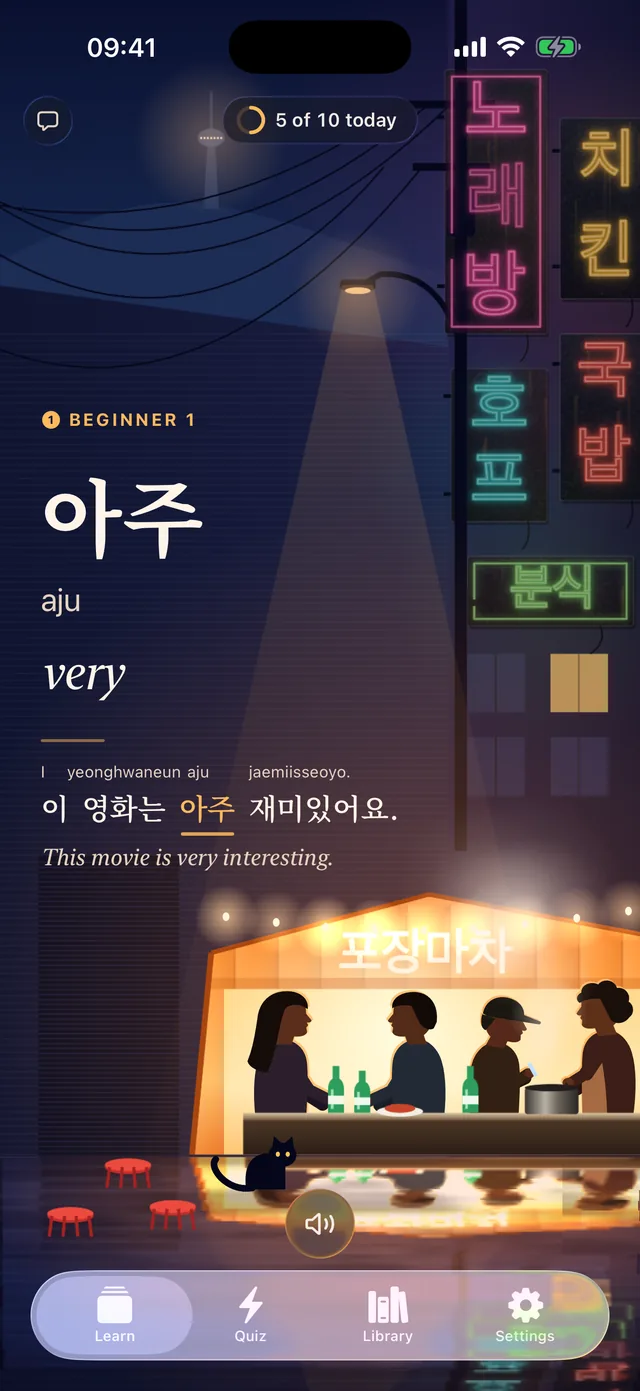
One letter, three answers. Every miss shows the right one, so a run is also a lesson.
Do you know this one?
Tap an answer, or press 1, 2 or 3
Twenty-four basic letters, 14 consonants and 10 vowels, which is the number most Korean sources give. Add the 5 double consonants and the 11 compound vowels built from them and there are 40, which is what you need to read every word. Eleven more consonant pairs appear only at the end of a syllable and are not usually counted as letters.
Many learners can sound out blocks after a few days of short daily practice, because the alphabet is small and regular. Telling the plain, breathy and tight consonants apart takes longer, and reading at speed takes months of exposure, which is what real words on a list or a Lock Screen are for.
Both mean 한글. Hangeul is the official Revised Romanization spelling; hangul is the older spelling, still the more common one in English. North Korea uses a different name for the same script, 조선글, usually spelled chosongul in English.
Because a letter sounds different depending on where it sits. ㄱ is a soft g at the start of a syllable and a k at the end, and ㅇ is silent at the start and ng at the end. The chart gives both where it matters, and the table of final sounds covers the rest.
South Korean dictionaries sort the first consonant as ㄱ ㄲ ㄴ ㄷ ㄸ ㄹ ㅁ ㅂ ㅃ ㅅ ㅆ ㅇ ㅈ ㅉ ㅊ ㅋ ㅌ ㅍ ㅎ and the vowel as ㅏ ㅐ ㅑ ㅒ ㅓ ㅔ ㅕ ㅖ ㅗ ㅘ ㅙ ㅚ ㅛ ㅜ ㅝ ㅞ ㅟ ㅠ ㅡ ㅢ ㅣ. The chart above groups the letters for learning instead, with the basic ones first.
Yes. The app is free on iOS: Beginner 1 is free in full, and every other pack opens with a free preview. Lock&Learn+ is an optional upgrade that opens every pack at once, offered as a yearly plan (with a 3-day free trial) or a monthly plan.